
⚠️ IMPORTANT DISCLAIMER
Before You Proceed:
Resetting Kodi to default settings will permanently delete all of your customizations, including:
- All installed add-ons and repositories
- Custom skins and interface settings
- Media library databases and watched status
- Playlists and profiles
- Add-on settings and configurations
Your actual media files (movies, TV shows, music stored on external drives or NAS) will NOT be deleted—only Kodi’s internal references to them.
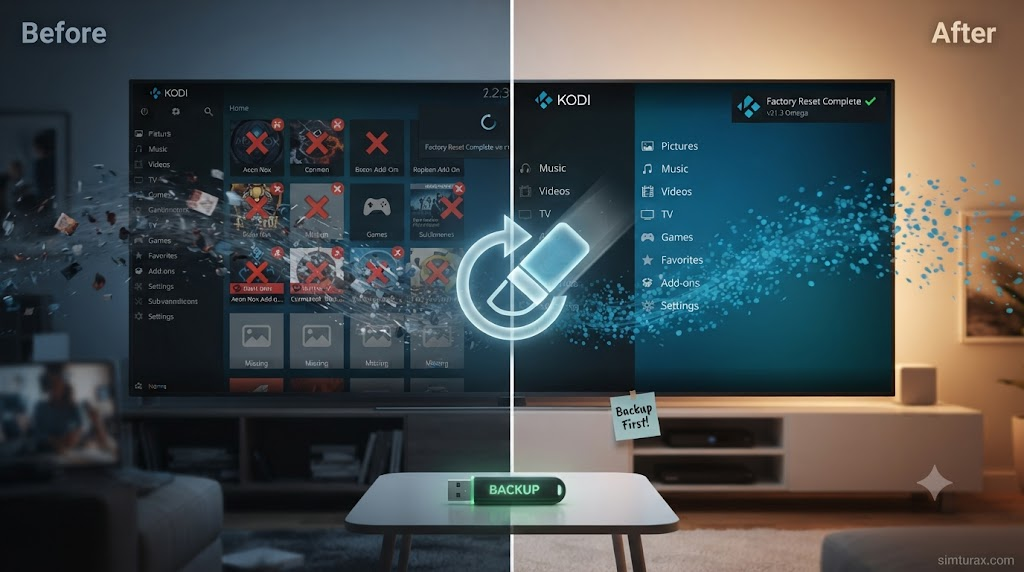
⚠️ STRONGLY RECOMMENDED: Before resetting, back up your Kodi data using a maintenance add-on like EZ Maintenance+ or manually copy your
userdatafolder to a safe location.Alternative Options to Try First:
- Clear Kodi cache only (Settings → System → Storage)
- Switch back to the default Estuary skin
- Disable recently installed add-ons one by one
- Update Kodi to the latest version
What Does “Resetting Kodi” Actually Mean?
Kodi does not have a single “Factory Reset” button built into its interface. Instead, resetting Kodi means removing the user data folder that stores all your settings, add-ons, library databases, thumbnails, skins, profiles, and custom preferences. When Kodi starts again without that data, it automatically rebuilds a fresh default setup—exactly as if you had just installed it for the first time.
Think of it like cleaning out a garage: uninstalling Kodi may remove the garage door, but the boxes inside can still be sitting there. A true factory reset clears the boxes too.
When Should You Reset Kodi?
A full reset is useful when normal troubleshooting has failed:
- Kodi crashes during startup or while playing media
- Add-ons are broken, outdated, or causing errors
- The interface is extremely slow due to too many skins, widgets, or cached files
- Your media library is messy, duplicated, or filled with missing artwork
- You installed a build and now want a clean, simple setup
- You are giving the device to someone else and want your settings removed
- You want to start over after years of testing random add-ons
If Kodi only has one small issue, try clearing cache, disabling a recent add-on, switching back to the default Estuary skin, or updating Kodi first. But if the app feels “haunted,” resetting is often faster than playing detective.
📋 “No-Click” Quick-Reference Cheatsheet
For experienced users—skip the reading and reset now.
| Platform | Method | Quick Command / Path |
|---|---|---|
| Windows (Standard) | Delete userdata folder | %APPDATA%\Kodi |
| Windows (Microsoft Store) | Delete userdata folder | %LOCALAPPDATA%\Packages\XBMCFoundation.Kodi_4n2hpmxwrvr6p\LocalCache\Roaming\Kodi |
| macOS | Delete userdata folder | ~/Library/Application Support/Kodi/ |
| Linux | Delete userdata folder | rm -rf ~/.kodi |
| Firestick / Fire TV | Clear app data | Settings → Applications → Manage Installed Applications → Kodi → Clear data |
| Android TV / Google TV | Clear app data | Settings → Apps → Kodi → Clear data |
| iOS / tvOS | Uninstall app | Delete Kodi app from home screen |
| Xbox | Uninstall & reinstall | Manage game → Uninstall → Reinstall from Store |
| LibreELEC / OSMC | SSH command | rm -rf /storage/.kodi |
🖥️ Method 1: Manual Reset via Userdata Folder Deletion
This is the most thorough method and works on all platforms. The core principle is simple: delete or rename the Kodi data folder. When Kodi launches and cannot find this folder, it creates a fresh one with default settings.
Windows (Standard Installation)
- Close Kodi completely (check system tray to ensure it’s not running)
- Press
Windows Key + Rto open the Run dialog - Type
%APPDATA%\Kodiand press Enter - The File Explorer will open the Kodi data folder
- Delete or rename the folder (e.g., rename to
Kodi_oldas a backup) - Restart Kodi—it will be reset to factory defaults
Windows (Microsoft Store Installation)
If you installed Kodi from the Microsoft Store, the data folder is in a different location:
- Close Kodi completely
- Press
Windows Key + Rand type:
%LOCALAPPDATA%\Packages\XBMCFoundation.Kodi_4n2hpmxwrvr6p\LocalCache\Roaming\Kodi- Delete or rename the folder
- Restart Kodi
Windows (Portable Installation)
If you use Kodi in portable mode:
- Navigate to your Kodi installation folder
- Find and delete the
portable_datafolder - Restart Kodi
macOS
- Quit Kodi completely
- Open Finder → Click Go in the menu bar → Select Go to Folder…
- Type
~/Library/Application Support/Kodi/and press Enter - Delete or rename the
Kodifolder - Restart Kodi
Note: The
Libraryfolder is hidden by default on macOS. Using “Go to Folder…” is the easiest way to access it.
Linux
- Stop Kodi if it’s running
- Open a terminal
- Run the following command:
rm -rf ~/.kodi- Restart Kodi
For LibreELEC / OSMC: The path is
/storage/.kodi
Android (Manual Method)
Note: On newer Android versions (Android 11+), accessing the
Android/datafolder may be restricted. Use the “Clear Data” method below instead.
- Use a file manager app that can access system folders
- Navigate to
Android/data/org.xbmc.kodi/files/.kodi/ - Delete or rename the
.kodifolder - Restart Kodi
📱 Method 2: Reset via System Settings (Android / Fire TV)
This is the easiest method for Android-based devices and is often the most reliable.
Firestick / Fire TV
- From the Firestick home screen, hover over the Settings icon (gear) and select it
- Select Applications (or Apps)
- Click Manage Installed Applications
- Locate and click Kodi in the list
- Click Clear data
- Click Clear data again to confirm
- Kodi has now been reset to default settings
- Launch Kodi by clicking Launch application
Alternative Method: You can also fully uninstall and reinstall Kodi:
- Settings → Applications → Manage Installed Applications → Kodi → Uninstall
- Confirm uninstall
- Reinstall Kodi using Downloader or the Amazon Appstore
Android TV / Google TV
- From the home screen, go to Settings (gear icon)
- Select Apps (or Applications)
- Select See all apps (or Manage installed applications)
- Find and select Kodi from the list
- Click Clear data
- Click OK to confirm
- Restart Kodi
Generic Android TV Boxes
- Go to Settings (gear icon)
- Select More Settings or Device Preferences
- Go to Apps → See all apps (varies by manufacturer)
- Find Kodi in the list
- Click Clear data or Storage → Clear data
- Confirm and restart Kodi
🍎 Method 3: Reset on iOS / tvOS
Kodi on iOS and tvOS is sandboxed, meaning all data is contained within the app itself.
iOS / iPadOS / tvOS
- From the home screen, press and hold the Kodi app icon
- Tap Remove App (or the X icon)
- Select Delete App → Delete
- Reinstall Kodi using AltStore, Cydia Impactor, or your preferred sideloading method
Note: Simply deleting the app removes all associated data. Reinstalling gives you a fresh default Kodi installation.
🎮 Method 4: Reset on Xbox One / Xbox Series X|S
- From the Xbox home screen, navigate to My games & apps
- Find Kodi in your app list
- Press the Menu button on your controller
- Select Manage game & add-ons
- Select Saved data → Delete all
- Confirm deletion
- Reopen Kodi—it will be reset to default settings
🧰 Method 5: Reset Using Maintenance Add-ons
If you prefer to reset Kodi from within the application itself, you can use third-party maintenance add-ons.
Indigo / Fresh Start
The Indigo add-on (available from the Fusion repository) includes a “Factory Restore” feature that wipes all configurations and restores Kodi to a clean state.
To install Indigo:
- Open Kodi and go to Settings (gear icon)
- Select File Manager → Add source
- Enter the Fusion repository URL (e.g.,
http://fusion.tvaddons.ag) - Name it “fusion” and click OK
- Go to Add-ons → Install from zip file → fusion → select the Indigo repository
- Install the Indigo add-on from the repository
- Open Indigo and select “Factory Restore” to reset Kodi
Configurator for Kodi
The Configurator for Kodi add-on also includes a “Rest Kodi to default/Factory reset” feature. It allows you to:
- Reset Kodi to factory defaults
- Clear Kodi cache
- Install multiple builds and switch between them
🥧 Method 6: Reset on LibreELEC / OSMC
For devices running LibreELEC or OSMC (common on Raspberry Pi):
Using SSH (Recommended)
- Connect to your device via SSH
- Stop the Kodi service:
systemctl stop mediacenter- Rename or delete the Kodi data folder:
mv /storage/.kodi /storage/.kodi.bakOr delete it permanently:
rm -rf /storage/.kodi- Restart the service:
systemctl start mediacenterUsing LibreELEC Settings
- From the LibreELEC home screen, go to Settings (gear icon)
- Select LibreELEC → System → Reset System Settings
- Follow the on-screen prompts to reset Kodi to defaults
🎨 Selective Reset: Reset Only Specific Settings
If you want to reset only certain aspects of Kodi without losing everything, you can delete individual files from the userdata folder:
| File/Folder to Delete | Effect |
|---|---|
guisettings.xml | Resets all GUI and skin settings to default |
Database/ folder | Resets media library (watched status, metadata, etc.) |
addon_data/ | Resets settings for specific add-ons |
Thumbnails/ | Clears cached artwork (saves space) |
keymaps/ | Resets custom remote/keyboard mappings |
To do this:
- Navigate to your
userdatafolder (see paths in the cheatsheet above) - Delete only the specific file or folder you want to reset
- Restart Kodi
🧰 Troubleshooting: Common Reset Errors
❌ “Kodi won’t launch after reset”
Ensure you deleted the correct folder (not the system installation folder) Try restarting your device completely If using Firestick, force stop Kodi first: Settings → Applications → Manage Installed Applications → Kodi → Force Stop Reinstall Kodi if the problem persists❌ “Can’t find the userdata folder”
On Windows, ensure you’re typing %APPDATA%\Kodi correctly (not %appdata%/kodi) On macOS, the Library folder is hidden—use “Go to Folder…” from the Finder menu On Linux, the .kodi folder is hidden—use ls -la to see it On Android 11+, access to Android/data may be restricted—use the “Clear Data” method instead❌ “Settings still remain after reset”
You may have deleted the wrong folder—ensure you deleted the userdata folder, not the program installation folder Some Kodi builds store settings in multiple locations—try uninstalling and reinstalling Kodi completely Check for a portable_data folder if using a portable installation❌ “Add-ons still appear after reset”
You may have only cleared cache, not data—ensure you selected “Clear data” not “Clear cache” On Firestick, try uninstalling and reinstalling Kodi instead Some builds install system add-ons that persist—a full reset should remove them❌ “Kodi is slow after reset”
Your device may be low on storage—clear cache regularly Consider using a maintenance add-on like EZ Maintenance+ for ongoing optimization Ensure your device meets Kodi’s system requirements Some older devices struggle with newer Kodi versions—consider an older version❌ “I accidentally reset Kodi and lost everything”
If you have a backup, restore it using your backup tool If you renamed the folder instead of deleting it, rename it back If you deleted the folder permanently, you may need to set up Kodi from scratch Data recovery software may help recover deleted files, but success is not guaranteed❓ Frequently Asked Questions
Will resetting Kodi delete my movies and TV shows?
No. Your actual media files (stored on hard drives, NAS, USB drives, or network shares) will not be deleted. Resetting Kodi only removes Kodi’s internal database, library entries, and settings—not the media files themselves. However, always verify where your files are stored before deleting any folders.What’s the difference between “Clear cache” and “Clear data”?
Clear Cache: Removes temporary files only—your settings, add-ons, and library remain intact Clear Data: Performs a full factory reset—all settings, add-ons, and library data are erasedCan I reset Kodi without losing my add-ons?
No. A full reset removes all add-ons. However, you can: Back up your add-ons using a maintenance tool before resetting Use the selective reset method to reset only specific settings while keeping add-ons Reset only the skin by switching back to EstuaryHow do I back up Kodi before resetting?
Install a maintenance add-on like EZ Maintenance+ or Backup Use the add-on’s backup feature to save your settings Alternatively, manually copy the entire userdata folder to a safe location After resetting, restore from your backupDoes uninstalling Kodi reset it?
On Android / Fire TV: Yes—uninstalling removes all data On Windows / macOS: No—uninstalling may leave the userdata folder behind On iOS / tvOS: Yes—uninstalling removes all dataMy Firestick won’t let me install Kodi after reset—why?
Newer Fire TV models (Fire TV Stick 4K Select – Oct 2025, Fire TV Stick HD – Apr 2026) run Vega OS, which does not support sideloading. To check your OS: go to Settings > My Fire TV > About. If you see Fire OS 7 or 8, you can sideload. If it says Vega OS, sideloading is impossible.How often should I reset Kodi?
Rarely. Resetting should be a last resort. Instead: Clear cache regularly (weekly or monthly) Remove unused add-ons Keep Kodi updated Use maintenance add-ons for routine cleanup✅ Conclusion
Resetting Kodi to default settings is a straightforward process that can breathe new life into a sluggish, cluttered installation. Whether you’re using Windows, macOS, Linux, Firestick, Android TV, or any other platform, the core principle remains the same: remove the userdata folder and let Kodi rebuild a fresh configuration.
Quick Reference:
| Your Device | Best Method |
|---|---|
| Windows PC | Delete %APPDATA%\Kodi folder |
| Mac | Delete ~/Library/Application Support/Kodi/ |
| Firestick / Fire TV | Settings → Applications → Kodi → Clear data |
| Android TV | Settings → Apps → Kodi → Clear data |
| Linux / LibreELEC | rm -rf ~/.kodi or /storage/.kodi |
| iOS / tvOS | Delete and reinstall the app |
| Xbox | Manage game → Delete saved data |
Before you reset, always remember:
- ✅ Back up your settings if you might want them later
- 🔍 Try simpler fixes first (clear cache, switch skins, disable add-ons)
- 🗑️ Delete the right folder—not the Kodi program files
- 🔄 Restart Kodi after resetting to see the fresh installation
- 🛡️ Use a VPN if you’re using third-party add-ons to protect your privacy