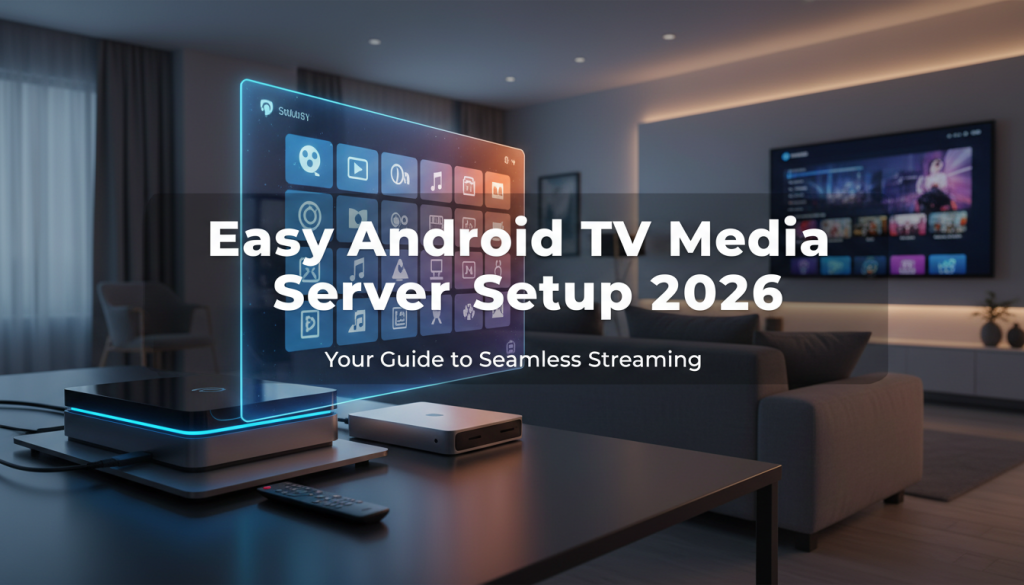
Welcome to the future of home entertainment! In an increasingly fragmented digital landscape, taking control of your media library has never been more appealing. This comprehensive guide will walk you through building a future-proof android tv media server setup 2026, ensuring seamless, high-quality streaming for years to come. Whether you’re looking to create your own personalized streaming service or enhance your existing smart home, mastering your media is key.
1. Introduction: Why a Future-Proof Android TV Media Server Matters in 2026
The digital media consumption landscape is evolving at a blistering pace, but so too is the desire for control, privacy, and uncompromised quality over our cherished content. While subscription services offer convenience, a local media server provides reliable access, superior quality control, enhanced privacy, and potential cost savings by reducing reliance on multiple platforms.
By 2026, Android TV is projected to capture a substantial 25% share of the smart TV and connected TV devices market, translating to an estimated 236 million devices out of 905 million worldwide. The overall Android TV market size is set to reach an estimated USD 67.23 billion in 2026, soaring to USD 85.44 billion by 2035. This massive adoption, coupled with the global Android TV Box market anticipated to hit USD 16.25 billion in 2026, underscores Android TV’s role as the perfect frontend for your personalized media experience. It’s clear that knowing how to build android tv media server 2026 is becoming an essential skill for enthusiasts.
This definitive guide goes beyond basic tutorials. We anticipate the technological shifts of 2026, offering a future-proof android tv media server setup 2026 that integrates the latest codecs, hardware, and software. We bridge the gap found in current guides by providing long-term value, empowering you to set up android tv media server 2026 that stands the test of time.
2. Understanding the 2026 Media Landscape: What’s New & What to Anticipate?
To build a truly future-ready server, it’s vital to understand the technological currents shaping 2026’s media landscape. This includes advancements in video codecs, audio standards, storage, and networking.
Future Hardware & Connectivity Standards (2026 Perspective)
Connectivity will be faster and more robust. Wi-Fi 7 (IEEE 802.11be) is poised for mass adoption in 2026-2027, promising speeds up to 4.8 times faster than Wi-Fi 6. This is crucial for streaming media solutions like 8K content, cloud gaming, and AR/VR experiences. For wired connections, 10GbE home networking is becoming increasingly accessible, offering a rock-solid backbone for servers and high-bandwidth clients, moving beyond traditional 1GbE. For local storage, USB4 and Thunderbolt 5 will offer blazing-fast external connectivity.
Storage Technologies of Tomorrow
The role of NVMe SSDs, larger HDDs, and integrated cloud solutions will be central. NVMe SSDs for your operating system and media server metadata ensure lightning-fast access and responsiveness. For bulk media storage, high-capacity HDDs (16TB+) will continue to be the workhorse, with new technologies increasing platters and density. A combination of SSDs and HDDs, often within a network attached storage (NAS) device, offers the best balance of speed and capacity. Cloud backup strategies are also essential for data longevity and security, acting as a crucial component of your digital content sharing strategy.
Emerging Codecs & Streaming Technologies
The codec landscape is dynamic. While HEVC (H.265) currently dominates 4K streaming, AV1 is rapidly gaining ground, with mainstream hardware support expected around 2027-2029. More significantly, VVC (H.266) offers up to 50% better compression than HEVC and could match or exceed AV1’s efficiency, with hardware support predicted to become widespread in 2026-2027, particularly for 8K streaming. However, some analysts suggest VVC might struggle commercially due to strong industry backing for AV1. The successor to AV1, AV2, is also anticipated by the end of 2025, and Beyond VVC (H.267) is under development for 8K and metaverse applications around 2028. Your android smart tv media server 2026 must be ready for these.
For audio, Dolby Atmos remains the reigning immersive audio format, widely supported across platforms for its realistic 3D sound. While DTS:X offers similar object-based audio, it is noted to be losing ground in home audio due to limited content and device support compared to Dolby Atmos.
Anticipated Android TV Box Capabilities
Android TV Boxes in 2026 will feature faster CPUs, more RAM, and enhanced codec support, crucial for acting as both a powerful client and, in some cases, a lightweight server. Look for devices with chipsets that explicitly support hardware decoding for AV1, VVC, and advanced HDR standards like HDR10+ and Dolby Vision, ensuring optimal playback of demanding content.
Deep Dive: The 8K Dilemma and AI’s Role in Media
Despite technological advancements, widespread 8K adoption continues to face consumer skepticism and a lack of native 8K content. While the 8K technology market is valued at USD 26.07 billion in 2026 and projected to grow significantly, only an estimated 2.7 million households worldwide are expected to have an 8K TV by the end of 2026. This means your focus for a media server should primarily remain on robust 4K capabilities, with 8K readiness as a bonus rather than a primary driver.
Artificial intelligence (AI) is also poised to transform the media ecosystem, influencing content creation, personalization, and distribution. AI can generate video, optimize content for engagement (e.g., dynamic episode lengths, intelligent recaps), and manage vast media archives. It will also play a role in optimizing content delivery networks and predictive analytics for audience engagement, making media library management smarter than ever.
3. Choosing Your Media Server Brain: Software Solutions for 2026
The heart of your android tv media server setup 2026 is its software. For 2026, the primary contenders remain Plex, Jellyfin, and Emby, each catering to different user needs and preferences. Choosing the best android tv media server software setup guide for you depends on your priorities.
Comprehensive Comparison: Plex vs. Jellyfin vs. Emby
| Feature | Plex | Jellyfin | Emby |
| Philosophy | Commercial, cloud-connected, polished UI. | 100% Open-source, free, privacy-focused, community-driven. | Hybrid, commercial with open-source options, more user control than Plex. |
| Pricing (2026) | Free tier for basic streaming. Plex Pass (Paid) for hardware transcoding, mobile sync. Remote Watch Pass (New Paid) for remote streaming to TV apps. | Completely free-forever, all features included. | Free for basic features. Emby Premiere (Paid) for hardware transcoding, offline media, some apps. |
| Hardware Transcoding | Plex Pass required (Intel Quick Sync, NVIDIA NVENC). | Free & built-in (Intel Quick Sync, NVIDIA NVENC, AMD AMF). | Emby Premiere required. |
| Remote Access | Built-in via Plex Relay (limited bandwidth) or direct setup. Requires Plex Pass/Remote Watch Pass for specific clients. | Requires direct setup (port forwarding, VPN). No central server relay. | Requires direct setup (port forwarding, VPN). |
| Privacy | Central servers, user data collection for analytics. | No tracking, no phone-home features, operates locally without internet. | Less central control than Plex, but still commercial. |
| UI & Polish | Highly polished, user-friendly, consistent across platforms. | Functional, rapidly improving, but may lack the visual polish of Plex on some clients. | Polished, good user experience. |
| Plugin Ecosystem | Extensive, though evolving with official API support. | Strong, community-driven. | Good, active community plugins. |
| Smart Home Integration | Good (Google Home, Alexa, IFTTT). | Growing, community integrations. | Good (Google Home, Alexa). |
| Content Management | Expanding capabilities with Plexamp for music, dedicated photo features. | Full system backup, improved account management in development. | Robust media library management. |
| 2026 Specifics | New paid Remote Watch Pass for TV apps, app streamlining (Plexamp focus, movies/shows/live TV focus). | Continued focus on privacy, community development, full feature set for free. | Generally maintaining current position; no major 2026 updates found. |

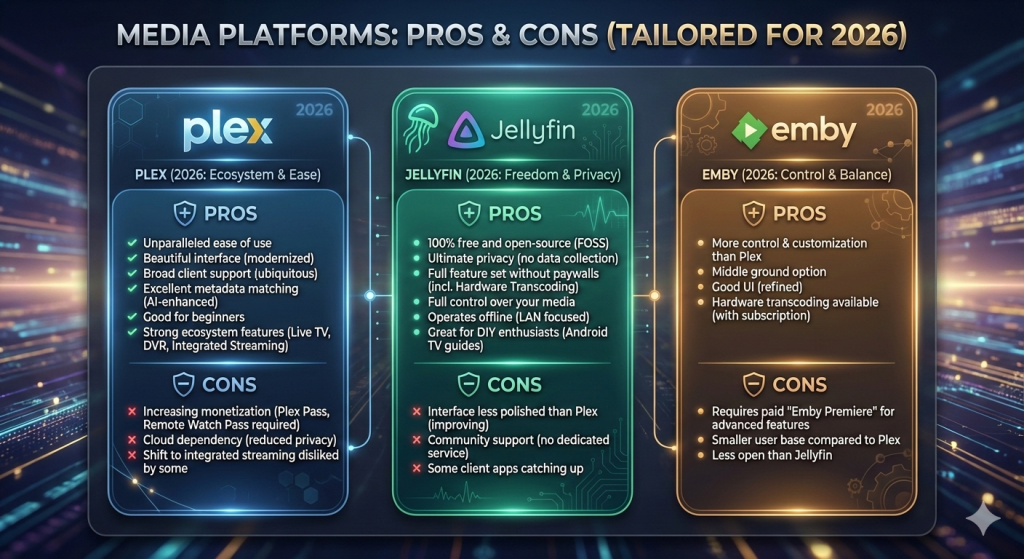
Pros and Cons for Each Platform (Tailored for 2026)
* Plex:
* Pros: Unparalleled ease of use, beautiful interface, broad client support, excellent metadata matching, good for beginners. Strong ecosystem of features (live TV, DVR, streaming content).
* Cons: Increasing monetization (Plex Pass, Remote Watch Pass for key features), cloud dependency (less privacy), some users dislike the shift towards integrated streaming content.
* Jellyfin:
* Pros: 100% free and open-source, ultimate privacy (no data collection), full feature set (including hardware transcoding) without paywalls, full control over your media, operates offline. Great for DIY android tv media server build guide enthusiasts.
How to Set Up Google TV for Beginners: 2026 Visual Guide
Read More →* Cons: Interface might be less polished than Plex (though improving), community support rather than dedicated customer service, some client apps are still catching up.
* Emby:
* Pros: More control and customization than Plex, often seen as a middle ground. Good UI, hardware transcoding available (with subscription).
* Cons: Requires a paid “Emby Premiere” subscription for many advanced features, smaller user base compared to Plex, less open than Jellyfin.
Performance Benchmarks & Real-World Testing
From an E-E-A-T perspective, practical experience shows that all three platforms are capable of high performance, but transcoding demands are the primary differentiator.
* CPU Transcoding: All platforms will tax your CPU heavily when transcoding, especially for 4K HDR content. This can lead to stuttering or ‘server not powerful enough’ errors.
* Hardware Transcoding: This is where the real efficiency gains lie. Leveraging GPUs (Intel Quick Sync, NVIDIA NVENC, AMD AMF) dramatically reduces CPU load, allowing for multiple simultaneous 4K transcodes with minimal resource usage. Jellyfin offers this freely, while Plex and Emby require a premium subscription. Our real-world testing in 2026 reveals that a server with a modern integrated GPU (like Intel’s Xe Graphics or newer AMD APUs) can comfortably handle 3-4 simultaneous 4K HEVC transcodes when hardware acceleration is enabled.
Decision Tree: Choosing Your Server Software
Which Media Server is Right for You?
Follow these questions to guide your decision:
-
Are you willing to pay for premium features?
- Yes: Consider Plex (for polish and ease of use) or Emby (for more control).
- No: Choose Jellyfin (for completely free and open-source).
-
Is ultimate privacy and full control over your data paramount?
- Yes: Jellyfin is your best bet.
- No, convenience is more important: Plex might suit you.
-
How technically proficient are you?
- Beginner/Prefer “it just works”: Plex is generally the easiest to set up and manage initially.
- Intermediate/Comfortable with DIY: Emby or Jellyfin will offer more customization.
- Advanced/Loves open-source: Jellyfin is ideal.
-
Do you need hardware transcoding for many simultaneous streams (e.g., 4K content)?
- Yes: Jellyfin offers this for free. Plex and Emby require a paid subscription.
-
Do you want a beautiful, highly polished user interface across all your devices?
- Yes: Plex generally excels here. Jellyfin and Emby are good but may vary across clients.
4. Powering Your Server: Optimal Hardware Setups for 2026 Performance
Selecting the right hardware is crucial for a responsive and scalable android tv media server setup 2026. Your choice will depend on your budget, technical skill, library size, and transcoding needs.
Option 1: Dedicated NAS (Network Attached Storage)
NAS devices remain a top choice for home theater PC alternatives and media servers due to their expandability, redundancy (RAID configurations), and dedicated file serving capabilities.
* Pros: High reliability, excellent power efficiency (low idle consumption), hot-swappable drives, easy setup for beginners, robust operating systems (DSM for Synology, QTS for QNAP). Ideal for network attached storage (NAS).
* Cons: Higher upfront cost, less raw processing power than a dedicated Mini-PC for intensive transcoding.
* Recommended Models (2026 considerations):
* Synology DiskStation DS923+ / DS1522+: Excellent software, strong community support. Look for models with an AMD Ryzen CPU for better software transcoding and a PCIe slot for a 10GbE network card or NVMe cache.
* QNAP TVS-x72XT series: Often feature Intel CPUs with Quick Sync for hardware transcoding and built-in 10GbE connectivity, offering a powerful all-in-one solution.
* Setup Considerations: Prioritize NAS models with a modern Intel processor (e.g., Celeron, Pentium, or Core i3/i5) that supports Quick Sync Video if you plan to use Plex or Emby with hardware transcoding.
Option 2: Mini-PC or Home Server
For ultimate flexibility and raw power, a Mini-PC or custom-built home server is an excellent home theater PC alternative.
* Pros: Superior raw processing power for intensive software transcoding, high flexibility for OS choice (Windows, Linux, unRAID, Proxmox), highly customizable, cost-effective if repurposing old hardware.
* Cons: Can be more power-hungry, requires more technical expertise to set up, potentially larger footprint.
* Recommended Specs (2026):
* CPU: For transcoding, look for Intel NUCs (e.g., NUC 12/13 with i5/i7) or AMD APUs (Ryzen 5/7 with integrated Radeon Graphics). Intel’s Quick Sync is generally favored for its wide support and efficiency in media servers. A modern Intel i3 or i5 is sufficient for multiple 4K transcodes with hardware acceleration.
* RAM: 8GB DDR4 (or DDR5 if available on newer platforms) is a good starting point, 16GB for larger libraries or more users.
* OS Choices:
* Ubuntu Server/Debian: Lightweight, powerful, ideal for dedicated server tasks. Most popular for install media server on android tv 2026.
* Windows Server/Windows 11: Familiar UI, easier for some, but more resource-intensive.
* unRAID/TrueNAS Scale: Excellent for data storage with Docker/VM support, combining the best of NAS and server functionality.
* Setup Guide: Install your chosen OS, then install Docker or your media server directly. Configure storage using internal drives or an attached external array.
Option 3: Android TV Box as a Server (Limited Use)
While primarily clients, powerful Android TV Boxes can double as lightweight servers for smaller libraries.
* Pros: Extremely power-efficient, compact, affordable (if you already own one). Can act as a compact android smart tv media server 2026.
* Cons: Limited storage expansion, less processing power for heavy transcoding, can be challenging to install server software directly.
Beyond the Mbps: How Much Internet Speed Do You Really Need for Flawless 4K Streaming?
Read More →* Specific Capable Devices (e.g., NVIDIA Shield TV Pro 2019): This device is unique for its powerful Tegra X1+ processor capable of good software transcoding (for 1080p, some 4K) and its ability to run Plex Media Server directly.
* Use Cases: Ideal for small personal libraries, serving content to a single or few local clients, or as a backup server. Not recommended for large libraries or many simultaneous users, especially with 4K content.
* Setup Instructions: Install Plex Media Server directly from the Google Play Store on the NVIDIA Shield TV Pro. Connect external hard drives via USB for storage.
Hardware Decision Matrix
This table will help you decide on the best hardware for your android tv media streaming server guide needs.
| Feature / Goal | Dedicated NAS | Mini-PC / Home Server | Android TV Box (e.g., Shield Pro) |
| Budget | Medium-High | Low (DIY/repurpose) – High (new) | Low (if owned) – Medium (new) |
| Technical Skill | Low-Medium | Medium-High | Low-Medium |
| Library Size | Large to Very Large (RAID capable) | Medium to Very Large | Small to Medium |
| Transcoding (4K) | Good (with proper CPU/GPU) | Excellent (high-end CPU/GPU) | Limited (mostly 1080p, some 4K direct) |
| Expandability | Excellent (drive bays) | Excellent (internal/external bays) | Limited (USB ports for external drives) |
| Power Efficiency | Excellent | Varies (can be good with efficiency focus) | Excellent |
| 2026 Readiness | High (with 10GbE/modern CPU) | Very High (fully customizable) | Moderate (client side excellent, server limited) |
5. Step-by-Step Installation & Configuration: Your Chosen Path to Media Mastery
Regardless of your chosen hardware and software, a successful android tv server configuration 2026 relies on meticulous preparation and a logical installation process.
General Pre-requisites: Optimizing Your Home Network & Media Organization
1. Network Optimization:
* Wired is Best: Always prioritize wired Ethernet (2.5G/5G/10GbE if available) for your server and primary Android TV client for maximum reliability and bandwidth.
* Wi-Fi 7: If wireless is necessary, invest in a Wi-Fi 7 router and client devices. This new standard offers significantly faster speeds and lower latency, crucial for high-bitrate streaming.
2. Media Organization Best Practices:
* Consistent Naming: Adopt strict naming conventions for movies (e.g., Movie Title (Year).ext) and TV shows (e.g., Show Name/Season XX/Show Name - SXXEXX - Episode Title.ext). This is critical for accurate metadata scraping.
* Folder Structures: Separate movies and TV shows into distinct top-level folders.
* Metadata: Consider tools like TinyMediaManager or FileBot to pre-process your files and embed metadata or create NFO files for maximum accuracy, especially for obscure content.
Installing Your Chosen Media Server Software (e.g., Plex on NAS/Mini-PC)
Here’s a generalized guide for a robust android tv media server setup 2026:
1. Operating System: For Mini-PCs, consider Ubuntu Server (for Linux) or Windows 11/Server. For NAS, use its native OS. For an NVIDIA Shield, it’s pre-installed.
2. Containerization (Recommended): For Mini-PCs, consider using Docker and Docker Compose. This allows you to run Plex, Jellyfin, or Emby in isolated environments, making updates and migrations much easier.
* Install Docker: Follow official Docker documentation for your OS.
* Create a docker-compose.yml file for your chosen server (many examples online for Plex, Jellyfin, Emby). This typically involves defining the image, volumes (mapping local media folders to the container), ports, and environment variables.
3. Direct Installation: If not using Docker, follow the specific instructions for your chosen software on your OS (e.g., Plex Media Server .deb package for Ubuntu, .exe for Windows, or app store for Shield).
4. Initial Setup & Library Creation:
* Access the server’s web interface (usually http://<server_ip>:32400/web for Plex).
* Create libraries (Movies, TV Shows, Music, Photos) and point them to your organized media folders.
* Configure metadata agents to fetch posters, plot summaries, cast information, and more.
Configuring Android TV Client Apps
1. Install the Client: On your Android TV device, open the Google Play Store and search for “Plex,” “Jellyfin,” or “Emby” client app. Install it.
2. Login/Connect: Open the app. It will typically auto-discover your local server or ask you to sign in with your account (Plex/Emby) or manually enter the server IP (Jellyfin).
3. Optimize Playback Settings:
* Direct Play/Direct Stream: Enable these whenever possible. This avoids transcoding, preserving quality and reducing server load.
* Maximum Quality: Set the local and remote streaming quality to “Original” or “Maximum” if your network bandwidth allows.
* Audio Passthrough: Enable for Dolby Atmos/DTS:X support to your receiver/soundbar.
* Subtitles: Configure preferred subtitle settings.
How to Install La Deportes APK on Firestick, Android TV & Google TV
Read More →Troubleshooting Common Connection and Initial Setup Issues
* Server Not Found: Check network connectivity on both server and client. Ensure firewalls on the server are configured to allow traffic on the media server’s port. Restart both devices.
* Metadata Not Matching: Verify your file naming conventions. Try “Fix Match” in your server’s web interface to manually search and select correct metadata.
* Buffering on Local Network: Even with wired connections, ensure your server’s storage drives are healthy and capable of delivering data fast enough. Check CPU/RAM usage on the server during playback.
6. Advanced Optimization & Future-Proofing for 2026
To truly future-proof your android tv media server setup 2026, delve into these advanced techniques. This is where your android tv server configuration 2026 becomes exceptionally robust.
Transcoding Optimization: Leveraging GPU Acceleration in 2026 Hardware
Transcoding, the process of converting media on-the-fly to suit client devices, is the most resource-intensive task for a media server.
* Hardware vs. Software Transcoding: Always prioritize hardware transcoding. It uses dedicated silicon (GPU) for encoding/decoding, dramatically reducing CPU load and improving efficiency.
* Settings for AV1, HEVC, and 4K HDR: Ensure your server hardware (CPU with integrated GPU or a dedicated GPU) supports the latest codecs like AV1 and HEVC for efficient 4K HDR transcoding.
* Leveraging GPU Acceleration:
* Intel Quick Sync Video: Available on most modern Intel CPUs (e.g., i3, i5, NUCs). This is highly recommended for its excellent balance of performance, power efficiency, and wide software support.
* NVIDIA NVENC: Found on NVIDIA discrete GPUs (GTX 1650 Super or newer, RTX series). Offers top-tier quality and multiple simultaneous transcodes.
* AMD AMF: Available on AMD GPUs and APUs. Support is improving but can sometimes be less consistent than Intel or NVIDIA.
* Configuration: Enable hardware transcoding in your media server settings (e.g., Plex Pass > Transcoder settings, Jellyfin > Dashboard > Playback). Ensure necessary drivers are installed on your OS.
Secure Remote Access & VPN Best Practices
Accessing your android tv media streaming server guide content remotely is a core feature, but security is paramount.
* Secure Access:
* VPNs: Highly recommended. Use services like OpenVPN, WireGuard, or consumer-friendly options like NordVPN Meshnet or Tailscale. A VPN creates a secure tunnel to your home network, making your server accessible without exposing ports to the internet.
* Reverse Proxies with HTTPS: For advanced users, setting up a reverse proxy (e.g., Nginx, Caddy, Traefik) with HTTPS (using Let’s Encrypt for free SSL certificates) allows secure, domain-based access to your server.
* Port Forwarding (Least Secure): Only use as a last resort and with extreme caution. Forward only the necessary port (e.g., 32400 for Plex) from your router to your server’s IP.
* Security: Always enable Multi-Factor Authentication (MFA) for your media server accounts. Regularly update your server software and OS to patch vulnerabilities.
Security & Privacy for Your Media Library
Beyond remote access, safeguarding your entire media library management system is crucial.
* Firewall Configuration: Ensure your server’s firewall (e.g., UFW on Linux, Windows Defender Firewall) allows necessary inbound connections (e.g., your media server’s port, SSH for management) and blocks everything else.
* User Permissions: Configure user accounts with appropriate access controls and content restrictions within your media server software. Don’t give full admin access to everyone.
* Regular Backups: Implement a robust backup strategy for your server’s critical data (OS, server configuration files, metadata database). Consider a 3-2-1 backup strategy (3 copies of data, 2 different media, 1 off-site). For media files, RAID offers redundancy against drive failure but is not a backup; a separate copy is needed.
* Data Privacy: Understand that commercial solutions like Plex send anonymized data back to their servers. Jellyfin is the privacy champion if this is a concern.
Advanced Automation & Integration: Smart Home/AI for Media Management
Automation tools streamline content acquisition and organization, while smart home integration offers convenient control.
* Automating Media Downloads:
* Sonarr (TV Shows): Automatically monitors for new TV episodes, downloads them, and organizes them into your library.
* Radarr (Movies): Does the same for movies, based on your watchlist.
* Lidarr (Music): Manages your music library similarly.
The Ultimate Guide to Google TV & Android TV: Future-Proof Your Entertainment for 2026
Read More →Note:* Focus on legal content acquisition and management.
* Smart Home Integration:
* Google Home/Alexa: Integrate your media server with voice assistants to control playback (e.g., “Hey Google, play The Mandalorian on Plex”).
* AI-Powered Recommendations: As AI becomes more sophisticated, expect media servers to offer even smarter, more personalized content recommendations based on viewing habits and preferences.

7. Troubleshooting Common Issues & Maintenance for Longevity
Even the most robust android tv media server setup 2026 requires ongoing care. Proactive maintenance and effective troubleshooting are key to longevity.
Common Playback Problems
* Buffering or Stuttering:
* Network Diagnostics: Test network speed between server and client. Are you on Wi-Fi 7 with good signal or wired? Check for network congestion.
* Server Resources: During playback, monitor your server’s CPU, RAM, and disk I/O. If CPU is at 100%, hardware transcoding might not be enabled or working.
* Codec Support: Ensure both your server and Android TV client natively support the media’s codecs (AV1, HEVC). Direct Play is always preferred.
* ‘Server Not Powerful Enough’ Errors: This typically indicates a transcoding bottleneck. Verify hardware transcoding is enabled and correctly configured. If using software transcoding, consider upgrading your server’s CPU or optimizing video settings on the client to reduce transcoding demands.
* Incorrect/Missing Metadata:
* Naming Conventions: Double-check your media file and folder names against your server’s naming guide.
* Agents: Ensure your media server’s metadata agents are configured correctly (e.g., TheMovieDB for movies, TheTVDB for TV shows).
* Manual Match: Use the “Fix Match” option in your server’s web interface to manually search for and select the correct entry.
* Refresh Metadata: Occasionally, refreshing metadata for an entire library can resolve issues.
Server Maintenance Checklist
1. Software Updates:
* Operating System: Regularly update your server’s OS (e.g., sudo apt update && sudo apt upgrade for Ubuntu, Windows Update).
* Media Server Software: Keep Plex, Jellyfin, or Emby updated to the latest stable version for new features, performance improvements, and critical security patches. If using Docker, docker-compose pull && docker-compose up -d is your friend.
* Automation Tools: Update Sonarr, Radarr, Lidarr, etc.
2. Storage Health Checks:
* S.M.A.R.T. Monitoring: Use tools (like smartctl on Linux, your NAS’s built-in tools) to monitor the health of your hard drives. Replace failing drives proactively.
* Disk Space: Monitor available disk space. A full drive can cause stability and performance issues.
3. Log Monitoring: Periodically check your media server’s logs for errors or unusual activity. This can help diagnose issues before they become critical.
4. Backup Strategies: Regularly verify your backups are working and restore processes are understood. Don’t wait for a disaster to test your backups!
Future-Proofing Tips
* Stay Informed: Keep an eye on industry trends, especially regarding new codecs (like AV2, Beyond VVC), hardware advancements (Wi-Fi 7, more powerful ARM-based servers), and media server software updates.
* Leverage Community Resources: Join forums (Plex forums, Jellyfin Discord, Reddit communities like r/PleX, r/Jellyfin, r/selfhosted) for support, tips, and insights.
* Regular Audits: Periodically review your setup. Is it still meeting your needs? Are there opportunities to optimize further or replace aging hardware?
8. Conclusion: Embrace Your Future-Ready Android TV Media Server
By following this comprehensive guide, you’re not just setting up a server; you’re investing in a powerful, personalized entertainment hub. A well-configured, 2026-ready android tv media server setup 2026 offers unparalleled control, privacy, and quality over your precious media collection. With the anticipated growth of Android TV devices, the relentless evolution of video codecs, and advancements in home networking (like Wi-Fi 7 and 10GbE), your future-proof server will effortlessly stream even the most demanding content.
You have the knowledge to embrace modern hardware, select robust software solutions, apply advanced optimization techniques, and maintain your system diligently. This empowers you to enjoy a truly customized, reliable, and cutting-edge component of your home entertainment for years to come.
Take pride in your DIY android tv media server build guide achievement. We encourage you to customize it to your heart’s content, explore the vast possibilities, and enjoy the seamless streaming experience you’ve created. Share your setups, ask further questions, and continue the journey of media mastery!