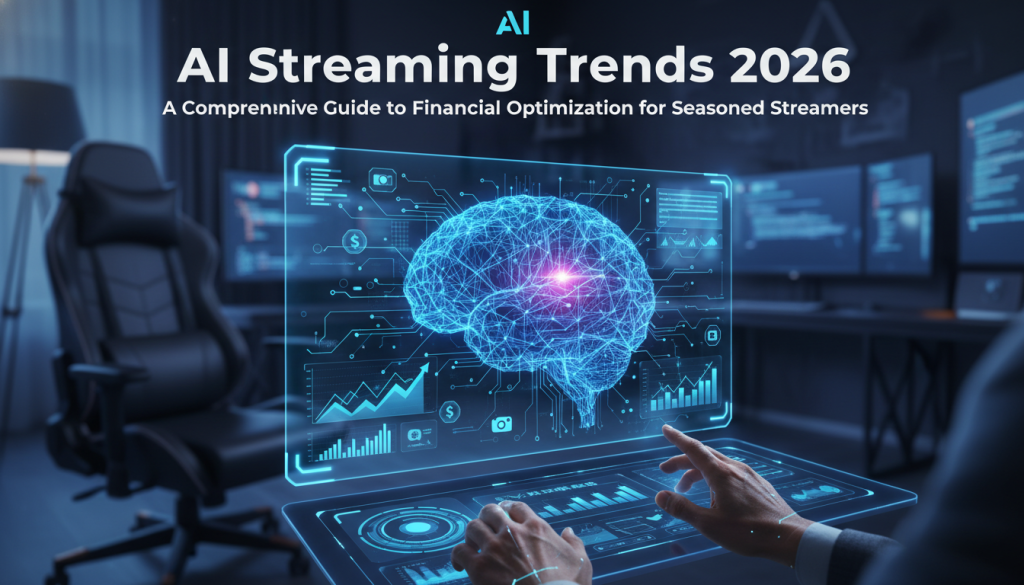
Introduction: The Dawn of AI-Driven Streaming Economics in 2026
The digital current is shifting, and for seasoned streamers, understanding the ai streaming trends 2026 is not merely an advantage—it’s an imperative for financial savvy. Artificial intelligence (AI) is rapidly moving beyond a supporting role, poised to redefine the economics, content creation, and audience engagement within the streaming industry. This isn’t about simple recommendations anymore; it’s a fundamental transformation.
By 2026, AI integration is expected to make streaming more immersive, efficient, and globally accessible, acting as a crucial driver of change across the sector. The live streaming industry itself is projected for exponential growth, with forecasts indicating an increase from $126.4 million in 2024 to an astounding $534 billion by 2030. This monumental growth underscores AI’s critical role in driving this expansion and highlights the unprecedented financial optimization opportunities it presents for those who strategically adopt these technologies. A vast majority of global organizations, 87%, already believe that AI technologies will offer a competitive advantage, underscoring its transformative financial implications through improved efficiency and reduced costs.
This comprehensive guide will delve into these profound shifts, exploring AI’s direct impact on your wallet through financial optimization, emerging 2026 streaming AI predictions, critical ethical considerations surrounding data privacy and hyper-personalization, and actionable strategies for thriving in this AI-powered landscape. Prepare to navigate the future of AI streaming with confidence and foresight.

AI’s Direct Impact on Your Wallet: Financial Optimization Strategies for 2026
AI offers multifaceted approaches to financial optimization for streamers, shifting how both content creators and consumers interact with streaming cost optimization.
Dynamic Pricing Models & Personalized Subscription Bundles
By 2026, AI will go beyond traditional pricing, delving deep into individual viewing habits to offer tailored pricing tiers and ‘just-right’ subscription packages. Imagine a world where AI algorithms optimize my streaming budget in 2026 not just for platforms, but for you.

The Ultimate Android TV Media Library Guide: Organize Your Content
Read More →The emergence of AI-driven ‘Smart Bundling’ services will become critical tools to manage and optimize multiple platform subscriptions, actively preventing overspending. These services will analyze your past and predicted future consumption patterns, suggesting optimal combinations of services. This directly addresses the question: How will AI recommendations reduce streaming subscription costs by 2026?
[link_card url=”https://simturax.com/cord-cutting-services-vs-devices/”]
Hypothetical Case Study: A seasoned streamer, Mark, previously subscribed to three major platforms, rarely using one. An AI-driven subscription management AI tool analyzed his watch history, identifying a consistent preference for sci-fi documentaries and niche esports. The tool predicted he would only engage with 15% of the content on his least-used service. It then suggested an optimal bundle, dropping that service and adding a specialized documentary platform and a cheaper esports-specific pass. This simple AI intervention saved Mark nearly $200 annually, demonstrating exploring 2026 AI-driven strategies for cheaper streaming services.
Personalized Ad Targeting & Its Effect on Consumer Costs
Hyper-targeted advertising, powered by AI, is anticipated to lead to lower subscription costs or more valuable free content tiers by 2026. This might sound counterintuitive, but the mechanics are clear: AI’s role in ad inventory optimization allows platforms to command higher ad revenues by delivering extremely relevant ads to viewers, minimizing waste. This efficiency gain can then be strategically passed on to consumers.
For example, artificial intelligence streaming trends indicate AI can optimize ad placement in real-time to minimize disruption and maximize effectiveness, leading to personalized ad experiences and higher returns on ad spend (ROAS) for advertisers. This economic model creates a virtuous cycle where better ad targeting translates into a better bottom line for platforms, potentially reducing the financial burden on the end-user or funding more premium content without additional fees. The impact of AI recommendation engines on household streaming expenses by 2026 could mean more bang for your buck, even with ads.
Churn Prediction & Retention: A Win-Win for Platforms and Consumers
AI helps platforms predict and prevent churn by identifying users at risk of leaving based on viewing patterns, engagement metrics, and past behavior. This proactive approach leads to more competitive pricing, loyalty programs, and personalized incentives for users, directly addressing concerns about what are the future AI trends in personalized streaming to save money?.

Fire TV Smart Home Integration: The Ultimate 2025 Master Guide (Alexa, ADB & Matter)
Read More →Furthermore, AI’s impact on content licensing and production costs for streaming platforms is significant. AI can streamline workflows, optimize content encoding, and manage bandwidth use efficiently, leading to substantial cost savings. Automated content moderation, for instance, can drastically cut down on time spent, potentially by up to 50%. These operational efficiencies reduce platforms’ overheads, and these savings can be strategically passed to consumers through better value offerings, making the future of media consumption more accessible and affordable. AI’s inherent ability to improve various operational aspects will likely lead to overall cost reductions and better forecasting capabilities for platforms, ultimately benefiting the consumer.

Beyond Recommendations: Key AI Streaming Trends for 2026 and Beyond
Beyond simple content suggestions, AI in streaming 2026 is ushering in an era of unparalleled engagement and creation.
Hyper-Personalized Content Discovery & Creation
The future of personalized content delivery goes far beyond current algorithms. AI will deliver real-time, context-aware experiences that adapt to individual user preferences and even moods. This includes dynamic adjustment of homepages, personalized thumbnail selection, and potentially incorporating biometric data like voice recognition and facial expressions for even more tailored content suggestions. Imagine AI predicting your mood and instantly curating a “comfort viewing” playlist or recommending a novel documentary you never knew existed.
Content creation itself will be profoundly impacted, with AI automating editing, captioning, and quality enhancement processes. Real-time, interactive video generation will allow creators to manipulate virtual cameras, lighting, and character expressions live, transforming AI from a mere generator into an interactive collaborator. “AI-native cinematography” will introduce novel camera movements and spatial effects previously impossible for humans. Dynamic adjustment of dialogue, visuals, and pacing based on audience data will enable unparalleled customization. The rise of AI-animated storytelling and hyper-real “Fake Life” vlogs is anticipated to dominate feeds, offering new creative avenues.
Interactive & Immersive Experiences
AI streaming trends 2026 point towards a significantly more interactive landscape. AI-powered chatbots will foster more interactive and inclusive experiences, answering viewer questions, running polls, and even engaging in natural language conversations. Real-time translation and subtitles will expand global accessibility, allowing streamers to connect with diverse audiences without language barriers.

The Ultimate Fire TV Smart Home Dashboard Setup Guide: Native Controls, Automation & Sideloading
Read More →Streamers will also benefit from dual-format streaming capabilities (vertical and horizontal) to cater to diverse viewing devices and AI-generated clips for easy content highlights, simplifying content repurposing. The integration of AI with immersive technologies like the Metaverse and spatial computing promises next-generation streaming experiences, allowing viewers to “step into” content or interact with virtual environments directly. Underlying these advancements, smart Content Delivery Networks (CDNs) powered by AI will reduce buffering by up to 30%, and AI-powered networks will become self-healing and self-optimizing, enhancing streaming reliability. AI agents are also expected to automate routine tasks and even coordinate complex projects, freeing up human creators for more strategic and creative endeavors.

The Ethical Frontier: Data Privacy and Hyper-Personalization by 2026
While hyper-personalization promises unparalleled user experiences, it presents a double-edged sword: convenience versus critical privacy concerns. The advancements in AI-driven experiences bring forth critical ethical considerations.
Navigating the deep waters of large-scale data collection for personalization raises significant privacy concerns and questions about user consent and transparency in AI algorithms. Concerns also include algorithmic bias, which can lead to the exclusion of smaller creators, and the creation of “filter bubbles” that limit users’ exposure to new genres or diverse perspectives. These biases, if unchecked, could shape the future of media consumption in unintended, potentially harmful ways.
To address these, responsible personalization will become a key differentiator. This necessitates transparent data practices, robust consent frameworks, and zero-trust data design as crucial for building and maintaining user trust. By 2026, there will be a strong focus on developing comprehensive AI governance frameworks, including tools for observability, interpretability, bias testing, and auditability. The emergence of “IPTech” tools will also assist artists in protecting their intellectual property in the age of synthetic content, utilizing methods like invisible digital watermarking to prove authorship and ensure fair compensation.
[link_card url=”https://simturax.com/vpn-guide-for-streamers/”]
Experts predict a “synthetic content crisis,” where up to 90% of online content could be AI-generated by 2026, necessitating a focus on human authenticity and voice to cut through the “AI slop.” Furthermore, AI is being used in sophisticated fraud detection, particularly in the music streaming industry, which faces a billion-dollar problem from AI-generated fraudulent content. Platforms are expected to tighten curation standards for AI-generated media to manage this influx. For seasoned streamers, understanding and managing their data footprint in an AI-driven ecosystem, and advocating for user data rights, will be paramount. Transparency in AI interactions will be paramount for maintaining customer trust.

Expert Outlook: Industry Predictions for AI in Streaming Economics (E-E-A-T Focus)
Drawing on insights from leading voices at institutions like AlixPartners, BDO, Forbes, MIT Sloan Management, and Andreessen Horowitz, 2026 streaming AI predictions paint a clear picture of an industry undergoing profound transformation. Industry experts predict that AI will profoundly transform the streaming landscape by 2026, making it more immersive and efficient.

25+ Best Kodi Addons 2026: Working, Tested & Compatible (Omega/Nexus)
Read More →Key predictions shaping the future of AI streaming include:
* Consolidation: The “streaming wars” are anticipated to end with the rise of “super aggregators” that bundle diverse entertainment, commerce, and community features, potentially through increased cooperation and mergers between existing platforms. This strategic move aims to create comprehensive ecosystems, offering consumers more value and streamlining subscription management AI.
* AI Agents: Agentic AI, autonomous assistants that can perform tasks, will become prevalent in daily life and the workplace, automating routine operations and coordinating complex projects. While 40% of such projects might be canceled by 2027 due to challenges, 2026 is seen as the year for “operationalizing AI agents,” signifying their growing maturity and application.
* Generative Content: Generative video is expected to move into a leading role in primetime content creation, making shows “better, not just cheaper.” AI will become multimodal, enabling creators to work with various content forms to generate or edit scenes in real-time, greatly enhancing content diversity and efficiency for data-driven content recommendations.
* Monetization Shift: A significant shift towards usage-based and blended subscription-and-consumption pricing models is projected, driven by the costs associated with delivering AI-powered products. Over half of producers anticipate growth in usage-based revenue by 2027, demonstrating a clear trend toward more granular monetization.
* Advertising Revolution: AI-driven digital advertising is predicted to be a cornerstone of success in 2026, leading to faster optimization, reduced ad waste, more precise targeting, and higher ROAS. Connected TV (CTV) will become a favored medium for AI-optimized advertisements. AI will be an embedded “fixture” in streaming ad tech, enhancing underlying efficiencies and fundamentally reshaping how AI in streaming 2026 generates revenue.
These projections underscore a future where AI isn’t just a tool, but a core component of the streaming economy, driving innovation, efficiency, and new revenue streams.

Strategies for Seasoned Streamers: Thriving in the AI-Powered 2026 Landscape
To thrive amidst these evolving ai streaming trends 2026, seasoned streamers must proactively embrace AI as an ally.

The Ultimate Kodi Keyboard Shortcuts List (2025): Essential Commands for v21 Omega & v22
Read More →Leverage AI Tools for Analytics & Engagement
Invest in AI-powered analytics to gain deep insights into audience behavior, preferences, and optimal streaming schedules. These tools can pinpoint viewer drop-off moments, allowing for real-time content adjustments. Implement AI-driven personalization systems and explore Natural Language Processing (NLP) for interactive experiences like intelligent chatbots and real-time translation. Utilize AI for automated content tasks such as editing, captioning, and generating personalized thumbnails or trailers. This comprehensive approach will help you answer Can AI algorithms optimize my streaming budget in 2026? through smarter operational choices.
Strategic Content Adaptation
Develop smarter content strategies based on AI-derived insights, identifying popular content themes and adapting on the fly to maximize viewer retention. Focus on creating unique and engaging experiences that AI can enhance, rather than replace. Consider adopting dual-format streaming (vertical and horizontal) to cater to diverse audiences and devices, leveraging AI-generated clips for easy content highlights across platforms. This ensures your personalized content delivery meets audiences wherever they are.
[link_card url=”https://simturax.com/ultimate-guide-to-google-tv-android-tv/”]
Diversify Monetization with AI
Explore AI for smart advertising and sponsorship matching to secure more relevant and lucrative partnerships. AI can analyze viewer behavior and preferences to match streamers with ideal brands. Investigate new monetization models, including usage-based and blended subscriptions, which are gaining traction. Streamers can specialize in “AI creator” roles for ventures like “faceless channels,” using AI to assist with content ideas, scripting, and editing for monetization through platforms like YouTube, affiliate marketing, or brand endorsements. This proactively helps in exploring 2026 AI-driven strategies for cheaper streaming services not just for consumers but also for creators.
Cultivate Community with AI
Employ AI chatbots to foster more interactive and engaging viewer experiences, thereby building a loyal community. These bots can manage chat, answer FAQs, and even run polls. Explore emerging fan engagement models that allow direct support for creators, potentially using AI to personalize exclusive content or perks for top supporters.
Fire TV Stick vs. Roku 2025: Real-World Speed Tests & Buyer’s Guide for New Streamers
Read More →Optimize Operations and Embrace Learning
Reallocate routine and administrative tasks to AI, freeing up human resources to focus on higher-value, creative, and community-building activities. AI agents can automate routine tasks and even coordinate complex projects. Stay informed about AI advancements and be prepared to adapt to new technologies and ethical considerations. Focusing on a specific role and output, using AI as a powerful accelerant, will be key to success, ensuring your expertise remains at the forefront of the future of media consumption.

Conclusion: Your Future in AI-Enhanced Streaming
The integration of AI into streaming is not merely an incremental change but a fundamental reshaping of the industry’s economic and creative landscape. By 2026, AI in streaming 2026 will be an indispensable partner for seasoned streamers, offering unprecedented tools for financial optimization through enhanced content, targeted monetization, and deeper audience engagement.
Key Takeaways:
* Financial Optimization: AI will drive streaming cost optimization through smart bundling, dynamic pricing, and hyper-targeted advertising, fundamentally altering how will AI recommendations reduce streaming subscription costs by 2026? for consumers and boosting creator revenue.
* Hyper-Personalization: Expect real-time, context-aware content and interactive experiences powered by AI, setting new standards for personalized content delivery and addressing what are the future AI trends in personalized streaming to save money?.
* Ethical Vigilance: Navigating data privacy, algorithmic bias, and the rise of synthetic content will be crucial, emphasizing transparency and robust governance frameworks for artificial intelligence streaming trends.
* Strategic Adoption: Seasoned streamers must leverage AI for analytics, diversify monetization, and adapt content strategies to thrive, actively engaging with subscription management AI and data-driven content recommendations.
Success will hinge on a proactive approach to adopting AI technologies, understanding their ethical implications, and continuously adapting strategies to leverage these powerful tools for authentic connection and sustainable growth in an increasingly AI-enhanced streaming world. The future of AI streaming is here, and with strategic foresight, it promises unprecedented opportunities for those ready to embrace it.
`